Monday, 29 July 2013

Camino Inca - the journey to Machu Pichu

And so it finally came to pass (how very Tolkien of me) for us to undertake the Inca trail to Machu Pichu; a personal childhood dream of mine, less so for Aisling, an endurance test extraordinaire and a lesson in physical exertion, history, archaeology and culture. Would we survive the harsh climes of the Andean mountains? Would we become dead women at Dead Woman's Pass? Would the sungate at sunrise be as glorious as I hoped it would be?

I can happily report that we are still alive (as you can probably tell from me writing this blog entry) and that the whole experience left us breathless and speechless all at the same time. Except if I was too speechless I wouldn't have anything to say here and as you've probably guessed by now I like to wax lyrical rather a lot about our experiences. So here goes...

Day 1. We began our trek early on the first day and left the confines of our warm and cosy hostel at 5.30 am. We said goodbye to showers, flushing toilets and clean clothes and said hello to wilderness, fresh air and our fellow hiking companions - a couple from Melbourne, another from South Africa and another from Canada. We were also accompanied by a teacher from Darwin. Australians, we get everywhere. In addition we had two guides - Isa and Hernan, one chef, one sous chef, one waiter and 13 porters. 

After driving for two hours and stopping off for breakfast - the first in what was to be many a fine meal cooked in very rudimentary conditions, we arrived fresh-eyed and bushy-tailed at the start of our trek, or base camp, if I'm to ham up the story. After adjusting our backpacks for the umpteenth time, and initially refusing, then gladly accepting the pressure to buy ties for which to attach our sleeping bags, from Peruvian women who clearly know a thing or two about hapless and unprepared tourists about to embark on the Inca trail, we set forth into the unknown, or rather the entry point for Camino Inca.


Hiking poles at the ready

A word on backpacks. When you book the Inca trail you can hire porters to carry your belongings, up to seven kilos. Being the extreme physically fit pair that we are I, for some bizarre reason, thought we wouldn't need porters and thus didn't order any. Except when we arrived at our briefing everybody else in our group, who looked way more fit than we did, had a porter each to carry their belongings. Whoops.... (I don't think Ais was too pleased at my lack of forward planning). We each had to carry the following:

1 sleeping bag
1 roll mat

Insect repellent
Sunscreen
1 hat
Thermals - top and bottoms
1 rain jacket
2 jumpers
2 pairs of sexy swish-swish trousers
2 tops
2 t-shirts
1 pair of shorts
Underwear
Camera
Snacks
Money
Toothbrush and toothpaste
Baby wipes for washing (or a knacker shower as Ais likes to call it)
2 litres of water
Toilet roll

All squished into a 7-kilo rucksack, about the size of a 6-month-old baby.

Thankfully, you can hire locals along the way to carry all of the above for you (except your water, camera etc) and on the second killer day this is exactly what we did. Ais even splashed out and hired a porter for the third day. Something in hindsight I probably should have done as well, if only my stubbornness and stupid belief that I'm fitter than I actually am hadn't got the better of me. If only I could learn to accept the easy route in life!

Day 1 is referred to as a gentle hike, designed to break you in gently for the harder, more arduous days ahead. At only 12 kms in length the road was described to us as flat, or 'Peruvian flat', as our guides liked to call it. After getting our passports stamped at the entry point we began our hike in earnest. 


Go team Inca. I have no idea why I'm striking a Village People-style pose...

Day 1 follows the brown Andes - mountains covered in scrub and dramatic rock formations rise out of the ground, forming shapes and shadows of folklores long forgotten; goats, donkeys and lamas navigate the steepest of slopes, while the river rushes through the valley below at breakneck speed, forming one of the thousands of tributaries that eventually make the mighty Amazon.


The brown Andes


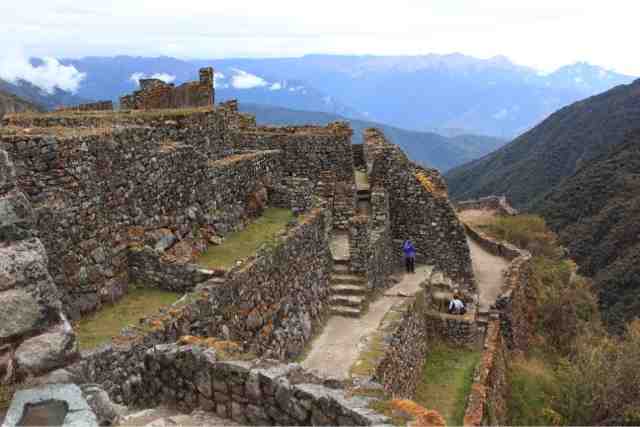
The first of many Inca sites


Ais takes a well-deserved break

It turns out that 'Peruvian flat' is a far cry from 'Lucy and Aisling flat'. As the path started to twist and turn, it also started to climb. If this was day 'easy', we started to feel an enormous sense of trepidation at what days two and threebmight be like. Still, we pushed on, becoming increasingly grateful for the hiking poles that we'd hired (Yep, it was that sort of trek), and stopping increasingly frequently to take in the view and regain our breaths. By 12 pm I had already consumed half of my snacks for the entire trip and was still ravenous for lunch. Thankfully lunch, and indeed all of our meals, turned out to be just one of the many highlights of the trek. 

We rounded a corner to find two blue tents erected - one for cooking; the other for eating. We were ushered into the latter and presented with a 3-course lunch, good enough for any Peruvian restaurant. Coca tea and coffee was followed by vegetable soup, which in turn preceded two stews, one meat, one veggie, fried trout, rice, potatoes, beans and salad. we finished with chocolate pudding and fruit. We had heard that the food on the Inca trail was good, but this blew our minds. And bear in mind that this was one meal out of 10, all of which had to be carried up and down the mountains by porters, who then prepared and cooked for us, all before us weary travellers arrived at each destination point. This was no mean feat to say the least, and I still maintain they were some of the best meals we consumed in the whole of Peru.

We began the afternoon's trek with renewed energy, and walked at a leisurely pace to our first campsite for the night to find our tents erected, snacks and dinner waiting for us, all set in a beautiful location situated at the base of a steep valley with white-capped mountains to the north, a starry sky that would match that found in the Australian outback, and a toilet system that would make any seasoned festival-goer think twice before using the facilities. As the clouds descended on us, our guide told us to look up at the highest peak. As we looked on wistfully at the pretty view he casually informed us that that was our route for day 2. Over the top of the delightfully named 'Dead Woman's Pass' and down, down, down into the jungle-coated hills of the green Andes. 

Day 2. We were awoken early at 5.30 am by our porters who each bring you a warm cup of coca tea and a bowl of water to wash your face in. Handily, we had both forgotten towels and the idea of drip-drying in temperatures below 5 degrees didn't fill us with glee, so we settled for baby-wipes and gratefully accepted our warm beverages. Thankfully, our super-warm sleeping bags had kept us generally warm through the night, although our roll mats didn't leave much space between us and the ground. Still, the thinner the roll mat, the lighter the weight.... After a hearty breakfast of quinoa porridge, pancakes smeared in dulce de leche, scrambled eggs, toast, fruit, coffee and more coca tea, we were as ready as we possibly could be for our big second day - a day that would either see us conquer the Inca trail, or descend back to the starting point with our tails and our pride stuffed well and truly between our legs.

A word on coca tea. Yep, coca tea is made with the coca leaf, that famous plant that has spawned drug wars, addictions and governed many-a corrupt state in South America. Yet the leaf on its own is completely harmless and is consumed everywhere throughout Peru and Bolivia. It gives no more of a 'high' than a regular cup of tea, yet is used by millions to assist with breathing at high altitudes and for its medicinal properties. Drunk with boiling water or chewed in the side of the mouth, it opens up the lungs and lets in more oxygen,man absolute necessity for locals and unfit tourists alike, trying to cope with the ever-decreasing oxygen levels at altitude. Over one million tons of coca leaves are consumed monthly by Bolivians alone, such is the importance of this leaf to the people and cultures in this part of South America. Sadly, the West don't realise its significance to local people in its natural form, and the American government are currently trying to impose embargoes on aid to Peru and Bolivia to try and curtail its production and consumption, even though both countries actively oppose illegal cocaine production (of which over 90% is exported for Western use).

This stage of the Inca trail was another 12 kms, but this time 8 kms would be straight up and 4 kms would be straight down, with no flat, 'Peruvian' or not, in between. With hiking poles at the ready and our backpacks in the loving arms of our private porter, we began our great ascent. Our guides Isa and Hernan are clearly used to hikers with varying fitness abilities, some with no fitness at all, who try to navigate the Inca trail. Isa went at the front, while Hernan brought up the rear making sure whoever was last in our group didn't lag behind too much, and probably also to ensure no one collapsed from sheer exhaustion, or fell off the side of a cliff. To our surprise we all had similar levels of fitness, and the order from front to back changed regularly enough for no one to feel like they were the worst in the group, or were holding people up. The key, it seemed, to reaching Dead Woman's Pass, was to take frequent breaks (and I mean every 50 metres or so), to take in the view, get your breath back (an increasingly hard feat at 4000 metres and climbing), and allow your legs to recover from the 3000-plus steps you needed to climb to reach the top. It also enabled our guides to give words of encouragement, as there's nothing more disheartening than having the top of the mountain constantly in view and feeling like you're not getting any nearer. In addition, this feeling is exacerbated by watching all our porters literally run past you as they race to get ahead, so they can set up camp, put up your tent and cook your lunch or dinner, all by the time you arrive at the next checkpoint.


I swear it was much steeper than it looks here!


Our goal, Dead Woman's Pass, or as our guides liked to call it, the 'boob'


Dramatic landscapes

A word on porters. These guys are super humans. Porters carry everything needed for the Inca trail, from tents, food, water, pots and pans to medical equipment, cutlery, tables, chairs, gas stoves, coffee pots and thermoses. Until recently, the weight each porter carries was not monitored, and some would  have to lug up to 80 kilos over the mountain passes with nothing but a small tip as their reward, if they were lucky. In some instances porters have also been known to carry tourists - usually fat Americans who get stuck half way up Dead Woman's Pass. The record for the heaviest tourist carried to the top of the pass is 110 kilos. Thankfully, rules and regulations are now in place to cap the weight each porter can carry at 20 kilos. This is still incredibly heavy (bearing in mind we couldn't carry our 10-kilo backpacks for the whole day), and made even more admirable by the fact that the porters complete each leg of the trail in a fraction of the time we do, by literally running past you, as you struggle to climb the next step without falling over. More often than not, they wear nothing on their feet other than a pair of rubber sandals made from old tyres and consume nothing more than the odd glass of chicha (fermented corn juice). Apparently, none of them hydrate with water during the trek, and survive solely on this alcoholic juice that closely resembles a glass of thick warm sick (see previous posts on Colombia for a similar interpretation!). By the time you've crawled to the next check point, they are patiently waiting for you, with food at the ready and a bemused look on their faces. At no point did we ever take for granted these super heroes who made our trip so enjoyable and enabled us to eat like kings and sleep in comfort at over 4000 metres. Porters, I salute you!

After restocking our energy levels with lunch at 3500 metres, we were ready for the last push. With the summit becoming increasingly closer I pushed in ahead and was actually the first person to reach the top of the pass (I'm still not sure how I achieved this). As it started to snow, I looked down to see Ais coming in at fourth place. We made it! With freezing temperatures and lungs full of thin air, we looked back on our achievement and the beautiful vista, before turning around and contemplating the downward slopes into the lush green Andes. 


Victory!


Looking a little bedraggled, but very pleased with myself


Looking back at the bottom


And at our downhill route. Hurrah!


From whence we came


The valley below

We arrived two hours later at camp with sore legs and big grins on our faces. We were even compelled to make a short video blog (see below)*. Apologies that its unedited, I'm sure imovie is super-easy, but without access to a YouTube tutorial I just can't work it out (sorry Penny!). I'm also aware that the camera adds 7-kilos, but I swear I haven't put on that much weight (although I might have done by now). I'm putting it down to horizontal stripes being a bad fashion choice on my part! I also apologise that the view I'm trying to show isn't exactly a view, more a vomit-inducing wrench of the camera that shows little other than clouds. Hey, I've never claimed to be a film maker...

*turns out you can't add iMovies with the blogger app, so until I work out how to do it, you'll have to wait on tenterhooks.... I know, I know, you're as upset about it as I am!

Day 3. There is nothing worse (well maybe nuclear war) than waking up in the middle of the night needing the bathroom when camping. Especially, when its freezing cold, you have nothing but a small temperamental torch as your guide, and the banos are several hundred metres away, down the side of a steep cliff, complete with sheer drops and slippery rocks (not my forte). And all this three days after a rather upset stomach! After holding on until about 6 am and the first vestiges of light, I tentatively ventured down to see what delights campsite number two toilets would hold for me. On arrival, I poked my head around the corner to hear the sounds of dry-wretching coming from bano number two. Oh joy...

A word on Inca trail bathrooms. Actually, bathroom is too-kind-a word to use. At the start of the trail you can pay 1 soles for a luxurious toilet complete with seat, paper and flush-ability. By the end of day 1 the bathrooms are free (hurrah), but decline drastically in standards. Varying from holes in the ground to, well, more holes in the ground, it really is pot luck as to what you get. I never thought I'd be grateful to see a squat toilet with a flush, but the ability to stand, or squat, away from other people's shit became a golden ticket that would have people queuing from miles around to share in the experience. Now, I am not overly fussy, and as long as I'm armed with lashings of hand sanitiser I can usually cope with fairly basic amenities, but some of the bathrooms we saw actually made our eyes water and our lungs seize up. The worst part being the fear of your ever-increasing weary legs and weakening muscles giving way mid-stream causing you to land arse-first in a pool of poo. When we finally arrived at Machu Pichu I have never seen so many happy faces literally skipping out of the bathroom at the experience of having a seat to sit on, toilet paper and the ability to flush away 4 days worth of food. You really do learn not to take things for granted when the simple things in life are taken from you.

But, back to bano number two. After fearing with dread at what might lie within, after hearing the sultry sounds of the fellow before me, I can thankfully report that it actually wasn't that bad and he was just basically a big girl's blouse. Finally feeling much better at the state of my empty bladder, I made my way back up the hill for breakfast.

We were told day 3 would be the most scenic day. After a two-hour climb passing several Inca sites, we would start our descent down to Machu Pichu, through lush green cloud forests giving way to stunning vistas, wildlife and finally a view of the mountain we'd come to see.

After getting all cocky at being the first in our group over Dead Woman's Pass, I naively believed the final two-hour hike up the final pass would be a doddle, and so turned my nose up at the offer of a porter to carry my belongings for this stage of the trek. Big. Mistake. I don't know whether it was because I'd used up all my energy the day before, or if the additional 10 kilos pressing into my back prevented me from breathing properly, or if my body was just fed up with physical exercise, but try as I might I just could not get up that hill. At one point there were nearly tears. Poor Hernan had to carry my sleeping bag, Ais had to carry my water and I literally crawled up the last 100 metres. Both my body and my pride were severely hurt. I can honestly say those two hours were way worse than the previous day's 8 km climb. I was extremely grateful to get to the top and vowed never again to climb a pass with my backpack in tow.

The rest of the day consisted of 'Peruvian flat', 16 km in total, but with views so stunning the pain in my legs quickly gave way to feelings of euphoria. Every corner gave way to different mountain sceneries. We were so high up, the birds flew beneath us; we'd stumble across Inca ruins every 30 minutes and clamber over the walls for the best photo opportunity. The drops to the valleys beneath us alone were enough to take our breaths away, and I could have happily walked another 16 km, just to experience it all over again.


Finally at the top


An Aisling. A creature rarely seen in the Andes. Note her red plumage - a warning sign to others to keep away.


No captions required...

In fact, we did take a detour to see some marvelously preserved ruins, such was the adrenaline rush we had by the end of the day. The extra hour's trek rewarded us with grandiose views of Machu Pichu mountain, my only experience of vertigo of the whole trip, when faced with having to climb down vertical stairs that literally seemed to fall off the mountain, and a family of lamas that were hanging out on 600-year-old terraces, blissfully unaware of the history they were chewing on.


Inca terraces with Machu Pichu mountain in the background


Lama love...

The only downside to the day came when Isa informed us that there had been a landslide on the final path to the sungate at Machu Pichu. Apparently the road had been closed for the last two days, and he hadn't had the heart to tell us. All the groups ahead of us had had to walk down to the local town, Agues Calliente, and catch the bus up to Machu Pichu along with all the other hoards of tourists, thus missing the entrance to the sungate at sunrise (one of the main reasons for doing the Inca trail), and having to endure the archaeological site with 7000 other people. To say we disheartened would be to put it lightly. After walking solidly for three days, the thought of not being able to achieve our goal was heartbreaking. That night our group was incredibly quiet as we chowed down on our final supper and contemplated our final day without seeing the sun rise over Machu Pichu.

Day 4. We were woken up at 3.30 am and told the good news that the path had been cleared and we were able to make our final ascent. Hurrah! The group arose with renewed energy and chomped down on our last breakfast with excited contemplation and big sighs of relief. By 5 am we were waiting at the final checkpoint, with torches in our hands and anticipation in our tired bodies. 

The final hike to the sungate takes about two hours in the dark, so you have to leave early if you're to get there in time to see the sun rise. The sungate was built by the Incas, high above the actual site of Machu Pichu. At sunrise on December 21st the sun shines directly through the gate and on to the town below. It signified the importance of the sun to the Incas and helped celebrate rebirth and good tidings for the year ahead.

As the road twisted and turned as it hugged the mountainside, and became increasingly narrow in parts (there were several instances of yellow tape where a few tourists had met their demise), I became grateful for the cover of darkness as it meant I couldn't see the 450-metre drop directly to my right, that was sometimes just a little too close for comfort. 

At 6.45 am we rounded the last corner and were greeted by a ridiculously narrow staircase affectionately known as the 'gringo killer'. Climbing up on our hands and knees and praying to Pachamama that we wouldn't fall backwards into the abyss, we finally reached the top of the stairs, and what felt like the top of the world, and most definitely the apex of our trip. We had arrived at the sungate.

And. It. Was. Cloudy. But! We were all so happy at having reached the top, I don't think anyone cared less. The view was out of this world, and I'll carry the first glimpse I had of these mighty ruins to my grave. Yes, I shed a tear, and yes, my legs nearly gave way, but I would do it all again in the blink of an eye, just to experience the feeling of accomplishment and the beauty of seeing Machu Pichu stare back at me in all its iconic glory.

As we started to walk down the hill towards the site itself, taking as many photos as we possibly could, while taking in what our eyes were seeing and understanding what we had achieved, I think we all felt an air of serenity and calm. By arriving early we were able to take pictures without hundreds of tourists in the background. As we arrived at the entrance to the site, complete with hiking poles, dirty clothes, dishevelled hair and wobbly gaits, we felt an immense sense if entitlement to the site. Who were these people arriving by bus moaning at the 200 stairs they had to climb to see take in the view!?! And why were they staring at us? Maybe it was the smell! Either way, because of what we had endured we all felt we had far more reason to be there than everybody else. We came, we walked a bloody long way and we were rewarded with one of the most breathtaking vistas that this pair of eyes has ever seen.

I could write more about the site of Machu Pichu itself, but I think I have probably bored you all enough with our tales. I will therefore depart this blog with some of my favourite photos from our trip so far. I think they say it all and sum up our experience far better than any words I could write...


Our team at the sungate. Notice how I'm gripping that rock, due to the 300 metre drop that's just to me left. Don't know why I was worried, the rest of them would fall off first...


Sun temple


Terraces. The sun did come out in the end...


The crowds start to gather.


Miss Shling looking cool in singlet and gloves


This is the view the Incans at Machu Pichu woke up to every morning.


If you're one of the five people who have bothered reading to the end of this post, I thank you, and commend your patience at my endless ramblings.

Things...

For which I am grateful...

My sleeping bag. I never thought I would be so pleased to wriggle into this bag of joy every night. It has kept me warm on many an Andean night and has probably warded off bed bugs in the less salubrious of sleeping establishments we have sometimes found ourselves in. Smaller than my biggest jumper I remember buying my slug of warmth several years ago in London and thinking it cost a small fortune (back when I used to prefer to save money instead of spending it. Tsk). Eight years on I can safely say it is one of my most valuable possessions, up there with the camera and iPod.

Thermals. The day has finally arrived where I look on a pair of long johns lovingly and with glee whenever the temperature drops below 10 degrees.

Headphones. These little earbuds of joy are not just limited to listening to music. They also block out the sound of fellow dorm-mates who may snore, and for some reason decide that 6 am or 2 am is the best time to pack and then repack their bags.

Insect repellent. Self explanatory.

Fish. I know we all know by now that I love the ceviche, but fish in general really has got me out of a hole when a restaurant only offers beef, lamb, chicken, lama, guinea pig or pig skin for dinner. If only the fish felt the same way.

Having a pair of thongs to wear in communal showers.

Things I miss...

It sounds very 'first world problems' to suggest I miss things when we are seeing the most breathtaking sights every day, but sometimes, just sometimes you crave the little things for which most of us have become accustomed to.

Clean clothes. The idea of having a wardrobe full of clean clothes (in fact, I'd settle for just a drawer full of clean underwear) seems bliss. To not have to do washing every 10 days and to have more than three weather-appropriate outfits to wear at any one time seems like a world away.

The ability to put toilet paper in the toilet and not in an overflowing bin to the side.

Toilet seats.

Salad. If there is one thing that will make me sick (apart from ice), its lettuce washed in local water. Best avoided.

Being able to brush my teeth without the need for bottled water. See above.

Not having to wear thongs in the shower.

Good coffee. You would think, especially in Colombia, that good coffee would be readily available in South America. Not so. Sadly it's all exported to countries such as Australia where it is sold at exorbitant prices by stupid fancy cafes such as St Ali, and labelled with names like 'single origin'. We have yet to drink a decent coffee since leaving home, although I know we are incredibly spoilt in Melbourne.

Happiness is....

Riding the length of Lake Titicaca in a clapped out old bus, listening to some of my favourite tunes, while watching the crystal clear indigo waters of the highest lake in the world meet the pale cloud-flecked blue sky. In the background the backbone of South America, the white-capped peaks of the Andes rise up like giant dragons' teeth to connect the land with the sky above.

As you can probably tell I was feeling particularly serene and poetic when I wrote this. Five minutes later we arrived at a small town where we had to cross the river. 

Like this...


Puno

We spent our last day in Peru in a town called Puno, on the shores of Lake Titicaca.

Poo-hole, as we have affectionately renamed it is, well, exactly that, and that's all I have to say on the matter.

Tuesday, 23 July 2013

Lucy and Ais have a date with San Pedro

Before we left Australia, I decided that I'd like to embark on some sort of 'spiritual ceremony' during our time in South America, and after a San Pedro experience in Cusco was recommended to us, we booked a day in the Andes where we would hopefully reach a 'higher plain' and find our inner selves.

Neither of us was brave enough to sample ayahuasca, the famous Amazonian hallucinogen plant that is commonly used by indigenous tribes, and now increasingly by tourists looking to get high, but after reading about the more gentle experience from the cactus San Pedro, we decided to give it a go. San Pedro has been used by Peruvians for thousands of years and forms a significant part of their history and culture. Administered by shamans it is known for its healing qualities and has been attributed to curing some cancers, motor-neurone diseases and mental health problems. It has shaped stories about Peruvian history, from the creation of the earth to their relationships with the sky and the land. It is still used regularly today, although I get the feeling some of its significance has probably been lost, especially when foreigners can experience their own San Pedro day out. 

San Pedro is not particularly hallucinogenic. It is meant to let you look inwards and gain understandings about yourself and the way you view the world. It then challenges these perceptions and enables you to see your life with fresh eyes and a new appreciation for the world around you. Or that's what it's meant to do anyway. Completely natural and legal, San Pedro lasts for 10-12 hours and leaves you with no hangover.

So, in light of the above we were pretty excited, if not a little sceptical, about our day away with the Peruvian fairies. We rocked up to a very hippy hostel where we sipped chamomile tea and met our fellow 'San Pedrans' for the day. Everyone looked a little serious for our liking, and we began to feel that maybe we were weren't quite the right candidates for this spiritual adventure. Surely it's meant to be fun, right? We had been good and followed the requested diet of no alcohol, meat and fat the day before, so were feeling as pious as we possibly could under the circumstances.

We were driven into the mountains and met by Leslie who would be our shaman for the day (I know, typical shaman name). Leslie is a South African lady who has been administering San Pedro for over 20 years, after getting off-chops, sorry, I mean finding her spiritual path, with her guru in the Andean mountains. Leslie lives in a lovely house complete with wind chimes, hammocks, a round-house for administering ceremonies, a lovely garden for laying and throwing up in, and two very confused-looking dogs who wander around staring aimlessly at wasted people lying on the grass.

After the meet and greet we were taken into the ceremony room where we sat in a circle and each given a glass of gloopy syrup, which was our golden ticket to a higher plain. We then had to give thanks to pacha-mama (mother earth) and state our hopes for what we'd like San Pedro to do for us. All of this had to be done while holding a stick with a large crystal stuck on the end (as you can probably tell, we were really getting into it). There were nine of us in total at the ceremony. We took it in turns to drink our San Pedro and dutifully waited for the fun (I mean transcending experience) to begin. 

San Pedro doesn't taste bad, it doesn't smell bad, it is just quite possibly the thickest 'liquid' I've ever put in my digestive system. Something that thick should surely only ever come up, not go down. And for a few people, come up it did. Although not as vomit-inducing as ayahuasca, it still doesn't sit particularly well in the stomach and after 40 minutes or so individuals started running for the flower beds to 'purge themselves' as our shaman liked to put it. I, however, was determined to keep my $80 worth of cactus on the inside, and experience the full effects.

After you have consumed, and hopefully digested your San Pedro you are invited to take a mattress outside, be at one with the nature around you and let your inner journey begin. You're also not meant to talk to each other for the day, as this could interrupt the spiritual process, which meant Ais and I had to keep ourselves apart to avoid any giggling or disruptive conversations.

As I started to feel a little light-headed I looked around me and realised the other people on our group seemed to be having a slightly different experience to me. One poor girl was sobbing her heart out into a blanket, one guy was chanting Chantras while jumping up and down and waving his arms in the air, and another woman was alternating between sleeping and checking her emails. I looked over at Ais who was purposefully looking away from me, which I took as a sign she was probably thinking the same things. So, I sat still and tried really really hard to think about some of the significant things that have happened in my life, how I felt about them now, and what I could learn from them. Could San Pedro give me a different perspective on my insecurities and problems? Would I appreciate the people and world around me differently? Would I open my heart and my mind to a more holistic way of  perceiving the world? I put my iPod on to drown out the ohms coming from the nearby sound system, closed my eyes and concentrated on my inner self. Now, I do consider myself to be a bit of a hippy, and I would honestly love to find something that changes my perception towards my tendencies to negativity and over thinking. Would San Pedro provide the cure?

Possibly not. I finally lost my shit when I looked over at one guy who looked remarkably like Woody Harrelson complete with dodgy orange-tinted sunglasses. He was swaying to the 'music' with an inane grin on his face while holding his hands in front of himself which made it look like Woody was playing with his woody (thanks for the quote, Ben). This was all too much for me and I started laughing uncontrollably, which brought me out of any spiritual process I was going through. Ais caught my eye and it was game-over for both of us. We were sitting on our respective mattresses silently crying with laughter, desperately trying not to ruin the serenity for everyone around us.

Try as I might I just couldn't get in touch with my inner soul, and we were both clearly way below the spiritual plain of our fellow San Pedrans. That's not to say we didn't feel the effects of San Pedro; the world around us felt soft and squidgy, flowers and plants were fascinating to look at, and I think I spent at least three hours staring at the clouds, which seemed to morph into dragons, butterflies, demons and faces at every second given opportunity. I remember thinking I would love to see clouds in this way every day for the rest of my life, but I can unhappily confirm that they have converted back to their usual white fluffy pillows in the sky, and it was definitely the effects of San Pedro I was experiencing.  

By lunchtime we felt the effects starting to wear off; this, coupled with the fact that neither of us can say no, meant that we went in for round two. Excellent. Four more hours of staring at the sky and trying to be serious. I can safely say that at no point during the day did I ever experience an inner awakening, nor did I realise a different world perspective. From this, I can only conclude one of two things: I am either dead on the inside, or there is actually nothing wrong with the way I view my life and the world around me. I think I'll go with option two, even if it is a little self-indulgent... Maybe we would have a different experience if we took San Pedro more regularly, or maybe any problems we have are buried so deeply that no amount of San Pedro will ever bring them to the surface. In a way, I am quite sad I didn't feel something more, but hey, maybe I am just awesome after all!

The day finished with us sitting around a fire waiting for our taxis to come and collect us, while we sat next to a fat old Australian, who I swear kept morphing into Ursula the octopus from the Little Mermaid. Maybe San Pedro is hallucinogenic after all! As we left Leslie's garden we turned around to see three people from our group performing a cleansing ceremony on a girl who appeared to be convulsing and literally shaking her demons from herself. As the Chantras got louder and the sounds of dry-wretching became more frequent, we knew it was our cue to leave behind our path to enlightenment, and head back down the hill to normality and beer. 

Thank you San Pedro for a great day out and teaching us the wisdom that cynicism and a sense of humour are not so bad after all!

Thursday, 18 July 2013

Cusco - history, altitude and shopping, not necessarily in that order...

We have arrived in Cusco, national treasure of Peru, capital city of the Inca empire, tourist haven and party town, and the launching pad for our Inca trail to Machu Pichu. 

The peaceful city of Cusco sits 3700 metres above sea level in a deep valley surrounded by brown Andean mountains; it's historic centre filled with churches, museums and town squares in which to watch the world go by, while its suburbs creep up the mountain-sides, clinging precariously to the steep landscape at ever increasing altitudes and ever-decreasing temperatures. The town itself is full of history, which can be seen through its architecture and people - Incan stone walls run through lanes and streets, Spanish churches are built in between and on top of these walls, while Peruvian women in traditional dress wander around carrying baby lamas asking for photo, photo, PHOTO! There are many museums to get lost in, along with day trips further afield to the Incan sites of Pisac and Ollayantambo, two small towns situated in the Sacred Valley, places surrounded by jaw-dropping scenery.

Cusco apparently means 'navel of the world', and was named the capital of the Incan empire in the 12th century AD. At the time the empire stretched from Ecuador in the north to Chile and Argentina in the south, and covered the whole of Peru. The height of Incan power was in the hundred years preceding Spanish conquest, and a statue of its most infamous leader, Patchacutec stands proudly covered in gold in Cusco's Plaza de Armas.


Inca doorway


View from Plaza de Armas


And another view


Lucy does 'the Pachacuti' Horrible Histories style

We knew there would be plenty to see and do in Cusco, so we arrived nine days before our Inca trail was due to start. We also secretly hoped we could squeeze in a cheap trip to the jungle. We couldn't... That damn jungle! It apparently takes a few days to acclimatise to the altitude, so we decided to take it easy at first. Altitude sickness is weird - strangely enough, I am only feeling the first effects of it now, as I write this post-Inca trail. It can leave you breathless and winded, or with a headache not dissimilar to a hangover. (Not fair if you haven't been drinking!). It makes you feel like you've run a marathon when all you've done is climb a flight of stairs and can just make you feel thoroughly shit. 

Anyway, I digress. Ais seemed to need more time to acclimatise at first than me, in addition to being particularly unimpressed with Cuscan temperatures (yep, we're sympathising with the Melbourne winter at the moment), so I amused myself with a walking tour of the city, taking in the sites and trying to work out the best places to eat, which according to our current budget turned out to be the supermarket... Although the San Pedro market offered some interesting culinary alternatives with everything from pigs' heads to cows' snouts for sale. Not for the faint-hearted to say the least, and although not squeamish I am thankful there is little chance of me ever consuming these delicacies. I'm still not sure what cow snouts would be used for. Nose soup anyone?

Another classic Peruvian dish sold at the market and in local restaurants is cuy, or roast guinea pig. Laid out on barbecues with their little arms and legs splayed out in front of and behind them, they look like flying rodents, apart from the fact that they're crispy fried on the outside and they're eyes are missing. Sadly, I've yet to persuade Ais to try one, and they definitely fall into the carne category, which means they're out for me, although I don't particularly have any sympathy for the critters ever since one bit me when I was a child...

The other things sold prolifically at the market and on EVERY street corner in Cusco, is an unbelievable amount of tourist souvenirs, including everything you might possibly need for your stay in the cold climes of the South American Andes. Alpaca jumpers, hats, scarves, gloves, blankets, leg warmers, coats, trousers, shoes, all in exactly the same array of colors and designs. There are also tablecloths, baby holders, drinks holders, rugs, bags, jewellery, belts, nipple warmers.... The list goes on. There is no way to differentiate between each stall other than how good you are at haggling (and trust me, you get good!). Of course most people start off by swearing that they won't buy any of this tourist tat that makes them look like every other gringo walking round Cusco, but of course you get sucked in, and its cold, and the prices are cheap, and finally you end up feeling left out for not wearing the traditional gringo uniform. Ais and I are now the proud owners of two alpaca jumpers, two alpaca hats and two pairs of hippy trousers which Ais swears she'll never wear outside of South America, where as I'm pretty sure mine are destined to become pyjama pants or Meredith daywear at the very least....


Anyone for Peruvian tat?

Our first museum stop was the museo de pre-Colombian art, a place filled with the most immaculate artefacts I have ever laid eyes on; ceramics, wood, jewellery, all finely carved or painted with astonishing precision. Most items predated the Incas and in many instances clearly showed where they got their influences from.


Nazca bowls


Oh deer...


Llama jug

Our second stop was Qorikancha, an Incan palace, originally covered in gold, which the Spanish thoughtfully destroyed and built a convent over the top of - couldn't possibly have those heretics running amuck worshipping the sun with all that gold at their disposal. Best to steal the gold, kill the inhabitants and place some pious nuns in charge to ensure such atrocities don't happen again.... God would like that. Still, the resulting convent was quite beautiful to look at with its mix of Incan and Spanish architecture, and it was interesting to see how the site had changed over time. Also, the religious pictures of Jesus in a skirt were quite hilarious. Who knew Jesus was a cross-dresser!?!


Inca walls at Qorikancha

Our third excursion was a trip to the hills to find ourselves with San Pedro. This weird and wonderful day will get its own special blog report...

My fourth cusco experience was a joyous date with a bout of dysentery. Twenty four glorious hours of bed-ridden pain, taking in the sites of several bathrooms, my doonah, and the inside of several toilet bowls. I have absolutely no idea where I picked up this fabulous illness - three days before our Inca trek, I might add, just to make it extra delightful and worrisome. The thought of climbing several mountain passes, all the while looking for a suitable place to have a date with the eye of a needle didn't exactly fill me with joy. There was no option, hardcore antibiotics were needed. Dysentery may have killed Wolsey, but it wasn't going to get this weary traveller....

Thankfully I woke up the next day feeling sore, but much better. I rewarded myself with a trip to Pisac, a small village located in the Sacred Valley, famous for its Incan ruins and huge market, which sold even more tat than Cusco. We resisted the temptation to buy additional alpaca goodies and wandered round for a couple of hours before heading back up the hill to Cusco.


Inca ruins at Pisac

The final day before our trek was spent preparing for our adventure. Emergency toilet roll was bought, along with six large Sublimes (new favourite chocolate bar. Statistic.), batteries for torches, baby wipes for showering, and painkillers for our soon-to-be hurting muscles. With our backpacks filled we headed off to our briefing to learn exactly what would be involved on our trip to Machu Pichu.


Wednesday, 10 July 2013

From the Nazca Lines to Juanita the frozen mummy...

As I mentioned in my previous post, the coast of Peru was never on our original agenda; our intention being to sail down the Amazon instead, but with funds and time being somewhat lacking at the moment, we decided to skip the jungle (oh, broken heart), and make our way to Cuzco via Nazca and Arequipa.

Not all was lost though as this route allowed me to tick off one of my bucket-list items: the Nazca Lines, an unofficial ancient wonder that I've dreamt of seeing since I was a child (yes, I know, I didn't get out much).

The trip to Nazca from Huacachina was surprising in as much that we didn't expect the entire landscape to be as dry and as, well, desert-like, as it was. I know the Nazca Lines are in the direction of the Atacama Desert, but I didn't expect the whole of southern Peru to be like this, too.

The other the thing that struck us was the level of poverty in this region. It seems far more poor than Colombia, with half-built mud-brick houses lining the highway, often without windows or doors, people sitting around with nothing to do, surrounded by litter because they don't have the infrastructure or money to afford rubbish collection. It has also saddened me to see that many people living on the streets in Peru are old, hunched over carrying their worldly possessions on their backs with nowhere to sleep in absolutely freezing temperatures, either in the desert or in the mountains. It is quite heart-breaking to see, as is any homelessness, but for some reason seeing the elderly on the streets affects me more...

We finally arrived in Nazca with the pure purpose of allowing me to get on a small plane and fly over the desert for 30 minutes in search of the infamous Nazca Lines. Aisling (perhaps wisely) opted out of this excursion, due to a healthy fear of small planes, and chose to sit in a hostel for the day in the rather uninspiring town of Nazca.

Ok, brief history lesson...

The Nazca Lines were created (unsurprisingly) by the Nazca people approximately 1200 years ago in the deserts of south-western Peru. Long before Pizarro got his dirty mits on the country and even before the Incas ruled half of South America, Nazcan society had developed an advanced understanding of culture and art through pottery, sculpture and huge line drawings in the sand, the cultural significance of which are still today being debated. They're a bit like crop circles, but kosher...


'Gosh, it's a barren wasteland of a desert out there.'
'Turn the map over Sir.'

The Nazca Lines consist of a variety of 'pictures' spread out over several miles. There are multiple straight lines and rectangles that are hundreds of meters long, stylistic animals including a monkey, hummingbird, dog and a whale, and perhaps the most intriguing of all, a man carved into the side of a mountain, which looks remarkably like someone wearing a helmet, and has led to its name, the astronaut.


The astronaut can be seen at bottom centre


The spider


Hummingbird


Abstract parrot

These abstract drawings, together with the fact that archaeologists still aren't sure how such straight and accurate lines were created, have led some theorists (or more likely, crackpots) to suggest that this ancient civilization was either visited by aliens who created the lines to use as runways for their aircraft, or that the Nazca people had invented hot air balloons that enabled them to fly over and instruct people on the ground where to draw next.

In all likelihood, latest evidence suggests that the lines were created without access to the sky above and were made for religious purposes, either to worship the sky or to pray for water in terms of draught. Makes sense, I guess when you live in a desert. Still, whatever the reason for their creation, they are an absolute marvel to see, especially when seated in a 4-seater plane that has to bank 45 degrees so you can see them. The below photos really don't do them justice, especially as I had about 5 seconds to take photos all the while trying to absorb the view, before the plane quickly banked to the other side to allow the other two people in the plane to see the same thing.

All on all, they were a pretty awesome thing to see, and no photos will ever truly capture what I actually saw. They really are a mystery of history, and its easy to see how people get carried away with over-the-top theories and ideas about their creation. Maybe it's more magical not to know at all....


After safely returning to earth we headed to the bus station for an overnight trip to Arequipa, otherwise known as the white city. We arrived early in the morning and were greeted with blue skies, warm sunshine and an architecturally beautiful city with historic buildings all made from white stone. Surrounding Peru's second largest city (although its only a tenth of the size of Lima) were the white-capped mountains of the Andes including one very large and still active volcano, which has unfortunately decimated this city, along with earthquakes, several times.


Arequipa cathedral 


And town square

Our main reason for visiting Arequipa, apart from soaking up its history was to visit a museum that houses Juanita, the frozen mummy - one of the finest preserved mummies in the world. Egyptians, eat your heart out. Juanita was a 12-14 year old girl who was sacrificed at the top of Arequipa's closest volcano by the Incas approximately 600 years ago. Human sacrifice was commonly practiced in Incan history, and was seen as a way to appease the gods and guarantee good harvests. Sacrifice was regarded a privilege (although whether the poor victims felt this way or not, we'll never know), and poor 'Juanita' travelled the 500 kms from Cusco to Arequipa by foot, was ordered to climb the 6000-metre volcano before being clocked on the head and buried at the top. Not my idea of a fun day out....

It was a volcanic eruption several hundred years later that led to her discovery. A climber was ascending the volcano, making his way through the aftermath of the eruption when he noticed burial artefacts near the top. Looking around he could see no sign of a body, but correctly surmised that the eruption would probably have dislodged any skeletons. Enlisting the help of an archaeologist/mountaineer the duo reclimbed the mountain and ingeniously rolled rocks down the slopes to see which way they fell. Following the direction of the rocks they came across a perfectly preserved mummy, curled in a ball and complete with hair, clothes, jewellery and skin.

The quality of Juanita's preservation has enabled archaeologists to learn much about her life, where she came from and how she died. She now sits in a frozen box, in a very cold room, in one of Arequipa's many museums for all to see. Sadly photography was not allowed, but she looked very impressive, and you couldn't help but feel sorry for this poor girl who had walked for two weeks to her death. At least now she is preserved for time immemorial. 

We spent the rest of our time in Arequipa wandering its beautiful streets, popping our heads into cathedrals and churches and trying to spend as little money as possible... In the evening we said our farewells and jumped on another bus, this time headed for Cusco, in preparation for our Inca trail - the number one reason that brought us to this fascinating continent.... X

Sunday, 7 July 2013

Aunt Lucy reports from darkest Peru

After a rather long night at Bogota airport we farewelled magical Colombia and set forth for Peru. We landed at Lima airport in thick fog and headed straight for the bus station. From reports we had heard from fellow travellers Lima isn't the most welcoming place to visit in South America, and is notorious for tourist thefts and muggings. Unsurprisingly then, it wasn't on our list of must-see places, and we were quite happy to be just passing through. In fact, our original plan was to fly to Leticia, a small Colombian town deep in the Amazon on the border with Peru and Brazil, and catch a boat down to Iquitos - the world's most remote city. But, time being of the essence and the idea of spending a week on a boat with only a hammock to secure your valuables being a bit much even for these intrepid travellers, we opted to fly to Peru's coast and make our way overland to Cusco. This route would also give me the opportunity to tick off one of my bucket-list items - the Nazca lines. But I'll save that for the next post (I know, you're all waiting with baited breath, but I don't want to give everything away at once, now do I?)

Extremely tired and a little fed up we waited a further 3 hours for our bus. Now, we had heard that some Peruvian buses have a reputation for luxury, but we weren't expecting what turned up. Each seat had a pillow, blanket, tray table, wifi and the ability to recline nearly 180 degrees. You are also served food and drinks! Call me easily impressed, but I was well, very impressed. With a 6-hour bus journey ahead of us, it was wonderful to sit back, snuggle under a blanket (separately, of course) and catch a few zzzz's before our next destination, which was to be the desert oasis town Haucachina, or as the tourists affectionately refer to it, Huaca-fuckin-china - they even have a special cocktail named precisely that.

There is only one reason why anyone comes to Huacachina, and that reason is to sand board down the immense dunes that surround the village. We rocked up at night, so were completely oblivious to our surroundings, and our immediate impression of the place was just how freaking cold it was. We were in the desert, afterall. Yep, our thermal-filled rucksacks are about to pay dividends... Absolutely exhausted we bedded down for the night in a rather cold, grotty hostel and started to wonder what all the fuss was about.

We awoke the next morning after spending the night on two extremely rickety top bunks and ventured down for breakfast and looked out over a hazy view, wondering where these huge dunes could possibly be. Turns out the haze we were looking at was an actual sand dune... As the fog lifted and the sun shone through we were greeted with this stunning desert oasis, filled with a lagoon surrounded by palm trees and the biggest mounds of sand I have ever laid eyes on. THIS is Huacachina!


We hastily moved hostels to far better digs on the other side of the lagoon and spent the day lazing in hammocks and planning the next few stages of our trip (the amount of organising involved is endless!). Being a desert it of course warms up tremendously during the day before plummeting into the depths of a London winter at night-time; I actually think I've gone through my whole 'wardrobe' in two days. We hastily soaked up as many rays as possible before clambering on board a huge dune buggy and venturing into the desert.

Now, I've never been in what I would call a real desert before. Yes, I driven to Mount Sinai, and yes I've driven through the Australian outback, but this was Laurence of Arabia stuff, complete with sweeping sand dunes and vistas that wouldn't look out of place on Mars, or at the very least the middle of the Sahara. It was breathtakingly beautiful.


I had the tune to Laurence of Arabia in my head the whole time...


Luce and Ais strike a pose

But! Our mission was not to look at the scenery, or lack thereof, but to master the art of sand boarding, something that I would surely grasp quickly and excel at. Right? I think we all know the answer to this question. We had heard that most people sand board down the dune face first, this being the safest and most logical choice when you have no previous experience and are faced with a 45-degree 100-metre downward dune in front of you. Except our guide thought we should start off by standing on our sand boards and head down the dune snow-board style. I have never been snow-boarding before, and in all likelihood never will, especially after giving several people concussion on a school ski-trip many years ago, so I was less than enthralled with this suggestion. But, after much convincing and watching half our group succeed in navigating said dune, I put my best foot forward and teetered on the edge praying that I would arrive at the bottom in one piece. To be fair it could have been worse, I managed to stay up-right for about half the way down, precariously balancing on my board and plugging all my energy into staying upright. But, gravity inevitably prevailed and I could feel myself starting to wobble. Now, the thing with snow boards (I think) is that they have a disconnect mechanism if you fall over, to stop yourself from twisting your body and breaking several limbs in the process. The same can not be said for a sand board which has you strapped in by Velcro. In what felt like slow-motion, I felt my face get closer and closer to the sand, but with my feet still attached to the board and the downward tug of the dune still pulling me down, it wasn't a pretty landing. I will only say this, one butt cheek went one way, while the other was pulled down the hill in the opposite direction. I couldn't stand up for a few seconds and I actually believed I'd done some serious damage, not to mention the large quantity of sand that had just deposited itself in my crack. I hopped my way down the rest of the dune looking like a cartoon character who had just had its arse set on fire.

Ais of course had no such problem and thankfully we were allowed to go down face-first for the rest of our excursion (although I don't recommend screaming on the way down as otherwise you end up with a mouthful of sand). As the dunes got steeper the pain in my woeful behind lessened, and we finished up looking down at what seemed to be a sheer 180-degree drop. Surely, I couldn't do any more damage? So with our lives in the hands of a waxed piece of wood we hurtled down the largest sand dune I have ever seen at what felt like 50 kilometers an hour. I can totally recommend it!


Looking down on Huacachina at sunset

Of course we congratulated ourselves with several large cervezas, and I can happily report that two didn't become one, if you get my drift...

Thanks Huacachina, you certainly proved an interesting introduction to Peru. 

And now for something completely different...

Tuesday, 2 July 2013

Villa de Leyva and Bogota - a tale of two cities

Our last two destinations in Colombia could not have been more different - Villa de Leyva: a picture-postcard town that looks like something straight out of a movie set, and Bogota: Colombia's long sprawling capital, carved into a huge valley, with favelas clinging for life to its steep mountainsides, while the rich elite spend their days wining and dining, and being driven around by bodyguards. 

But I'm getting ahead of myself...

We started our trip to Villa de Leyva after farewelling the gorgeous San Gil, which we'd both grown to love (smelly person incident aside) and got on a bus that was supposed to only take 4 hours. It didn't. Firstly, we missed the bus we wanted to catch (ok, maybe our fault, but I'm not convinced there was actually a bus at this time), secondly it was by far the weirdest, most painfully drawn out journey we had been on. Ben and Alex were stuck down the back with a vomiting child and no flushing toilet, Ais was somewhere in the middle next to a guy who appeared to be ferrying a group of children from one town to another (I'm going with friendly Uncle as opposed to child trafficker), and I was at the front watching the bus driver play online bingo while driving us all to our deaths (sorry, I mean destination). After numerous stops, which seemed to achieve little other than to allow the driver to relieve himself, for hawkers to try and sell us stuff, and the police to come on board to check everyone's ID, we eventually arrived 6 hours later in Villa de Leyva. By this stage it was getting dark and - the worst shock of all - cold! (Ais was not happy). So we trundled off with our backpacks in search of our hostel. Being a small town we didn't think we needed a taxi, which was fine, but I now know that the maximum time I can walk with a 15-kilo rucksack, 5-kilo backpack and 2-kilo camera bag is about 10 minutes before I start to get grumpy. Especially, while trying to navigate big-cobbled streets in thongs.
We finally arrived at our hostel, which was very quaint, if a little strange, and immediately put our bags down and asked for beer. No beer! What kind of place was this? Clean-living? Tsk. So, we  trundled back into town and bought half a slab to share, over which we would contemplate dinner. 


Chill-out area at our hostel, with a parachute to protect you from the elements.

Arriving late at a new place always throws us a little: navigation, trying to avoid dodgy areas, bad restaurants, all seem to amalgamate together to form one confusing mess that results in us generally eating over-priced bad food. Villa de Leyva is apparently famed for its cuisine in this region. The pizza we ate did definitely not fit this category, although they were large enough to supply me with lunch for the bus trip to Bogota, much to Alex's horror (who I think secretly does like cheese, or is at least well on the way to becoming a lover of mild cheddar).

The next day we decided the best way to see Colombia's 'must-see weekend getaway town' was by the most obvious mode of transportation for anyone wanting to navigate a cobbled 17th-century town... By horse of course! This also gave me multiple opportunities to take photos of Ais on a 'horse outside', something that didn't cease to be funny until we'd finished our trek.

For some reason I (being the smallest) was given the biggest horse, and Ben, who probably comes in at about 6 ft 2 in was given the troublesome 'pony' who wandered along at the back with an attitude of a small disgruntled child that had been told to stand in a corner until it had 'thought enough about what it had done'. Ais had the 'alpha male' (of course) who insisted on being at the front the whole time, while I'm pretty sure my horse was heavily pregnant and just wanted to go to sleep. Still, we made a grand little troupe as we set out under blue skies with a slightly pervy Colombian as our guide, and had a thoroughly lovely time clip-clopping through the streets, taking in all the sights.


The horsemen (and women) of the apocalypse. The other five are camera-shy. See how bored my horse looks?


This house is made entirely from terracotta


It's a basket...


'If you're looking for a ride I've a horse outside...'

We spent the rest of the day chilling out on rather uncomfortable sofas (not too good, if you're a little saddle-sore), before promising to do better at our next restaurant choice.

We did definitely improve on the previous night's offerings, but it still wasn't exactly what I would call amazeballs food. It was extremely hard to find authentic Colombian dishes (and I guess if you're Colombian, then eating your own speciality cuisine on your long weekend away might seem a bit boring, so fair enough), so we ended up plumping for Mexican, which was good, but having just been in Mexico, a long way off the mark. Still, it's not all about food, I hear you cry (isn't it?), ah yes, I keep forgetting we're here to experience everything. 

With full bellies, eyes filled to the brim with stunning architecture and enough bites to play dot-to-dot on our legs, we set forth for Bogota.


South America's largest town square... Apparently.


And from the other side


Once in Bogota we ventured to our hostel, which was several blocks north of the designated backpacker area, as muggings are apparently quite frequent wherever tourists like to hang out, and we're not the bravest of souls. Also, I am damned determined not to lose my camera. Take my phone, take my credit cards, just mits off the DSLR and iPod (I realise my priorities may be a little skewed). 

Our first port of call was the incredible museo de oro, a museum filled with nothing but intricate gold artefacts found throughout South America. Not that it's an excuse, but it's no wonder the Spanish spent years in search of El Dorado, such was the proliference of gold found throughout the continent. Each artefact was beautifully presented, with explanations in English as well as Spanish (hurrah! There's nothing worse than trying to work out your 8th-century from your 10th-century archaeology when everything looks pretty much the same and is in another language). 


Gold! Always believe in your soul...

Feeling rich after consuming all that gold we headed to the local tat market, bought obligatory traveller wrist bands (one for every country!) and decided to splash out at Bogota's best ceviche restaurant (seriously, you'd think we'd be bored of the stuff by now, my phone even picks it up in predictive text). It certainly was up there with some of the best we've had. We each ordered a dish each to share, with the soy, orange and juniper-berry ceviche being the stand-out winner, although the tuna tartare came a close second. We all successfully succeeded in recreating the classic 'When Harry met Sally' scene with every new mouthful (the other guests probably thought we'd never seen real food), and washed it all down with a bottle of Viognier, the first wine I've had since leaving Australia. It was absolutely yum balls, although our wallets certainly paid the price.

The next day we visited the historic quarter and took obligatory photos of the town square and surrounding streets. I won't lie, in most places Bogota is a tired-looking town, in desperate need of a makeover. The majority of buildings haven't been modernized since the 70s, and there is a lot of poverty, which exacerbates the sad and depressing feel, the city centre gives. There are certainly rich parts, but they are such a world away from the grittiness of the 'real city' it's hard to see how the place will ever come together as one, due to the ever-growing divide between rich and poor. Shopping malls are erected, the new international airport looks spick and span with its glass exterior, while people living in favelas trying to eek out an existence that will never change all the while money is poured into sustaining tourism and the rich. Sorry, social commentary over, it was just something that really struck me in Bogota, more than any other place in Colombia, although I think Cartagena is the same, the government just don't want you to see the flip side of their precious Caribbean jewel.

In the afternoon we visited the museo de botero, an art gallery dedicated to this Colombian artist who specializes in all things fat, or at least making them look fat. Fat people, fat animals, fat fruit, fat sculptures, all with a couple of Picassos thrown in for good measure. We left feeling as though we'd all been on amazingly successful diets and headed for our final Bogota must-see experience - a cable car that takes you to 3500 m elevation up the side of a steep mountain for fantastic city views and our first potential experience of altitude sickness. Glorious views they certainly were, although it gets pretty cold when your that high up. We watched the sun set over the city with a beer in hand before descending for our last night in Colombia.


Plaza de Bolivar in Bogota


Fat!


One I drew earlier


A rose between two thorns

We treated ourselves to a trip to Mini Mal, a famous Colombian-fusion restaurant well-known for its attitude towards sustainability and pairing of unusual ingredients. It wasn't too expensive either - phew! Ais had sticky ribs cooked in some sort of dark ale, while I settled on a fish dish cooked with a traditional Colombian fruit which I can only describe as a mix between a tomato and a passion fruit. It was all rather lovely, although we were extremely sad to farewell Ben and Alex at the end of the night, who had been our travelling buddies for the last 10 days and have become firm friends. We miss them, their humour, and Youtube recommendations dearly.


We packed our bags for the gazillionth time, jumped in a cab, and headed out to Bogota airport for a 10-hour wait for our flight to Peru.

Colombia has amazed and humbled us; its beauty is second to none, and its people are warm and welcoming. I'm sure I'll vow to return to every country I visit, but in this case I know Colombia and I will meet again.